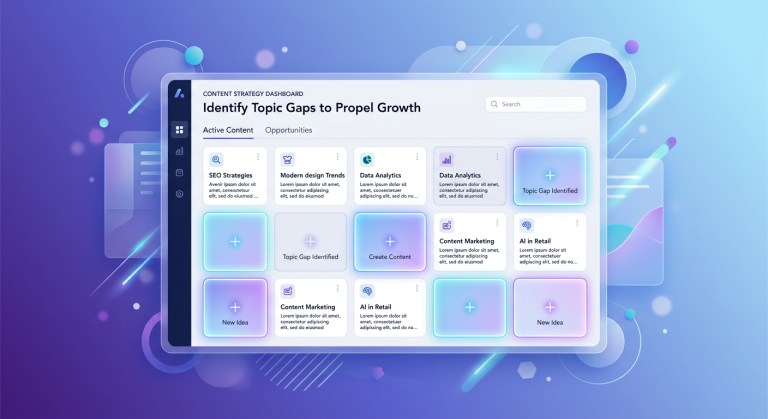
Yes, AI content can be excellent for SEO — Google has explicitly stated it does not penalize content simply for being AI-generated. What Google does penalize is low-quality, unhelpful content created primarily to manipulate rankings, regardless of whether a human or a machine wrote it. The publishers winning with AI in 2026 aren’t the ones mass-producing thin articles; they’re using AI strategically to fill genuine content gaps, maintain consistent publishing schedules, and build topical authority faster than any human team could alone.
Google’s Official Position: It’s About Quality, Not Origin
Let’s start with what Google has actually said, because there’s still a shocking amount of misinformation floating around. In February 2023, Google published its guidance on AI-generated content and updated it multiple times since. The core message has never changed: “Appropriate use of AI or automation is not against our guidelines.”
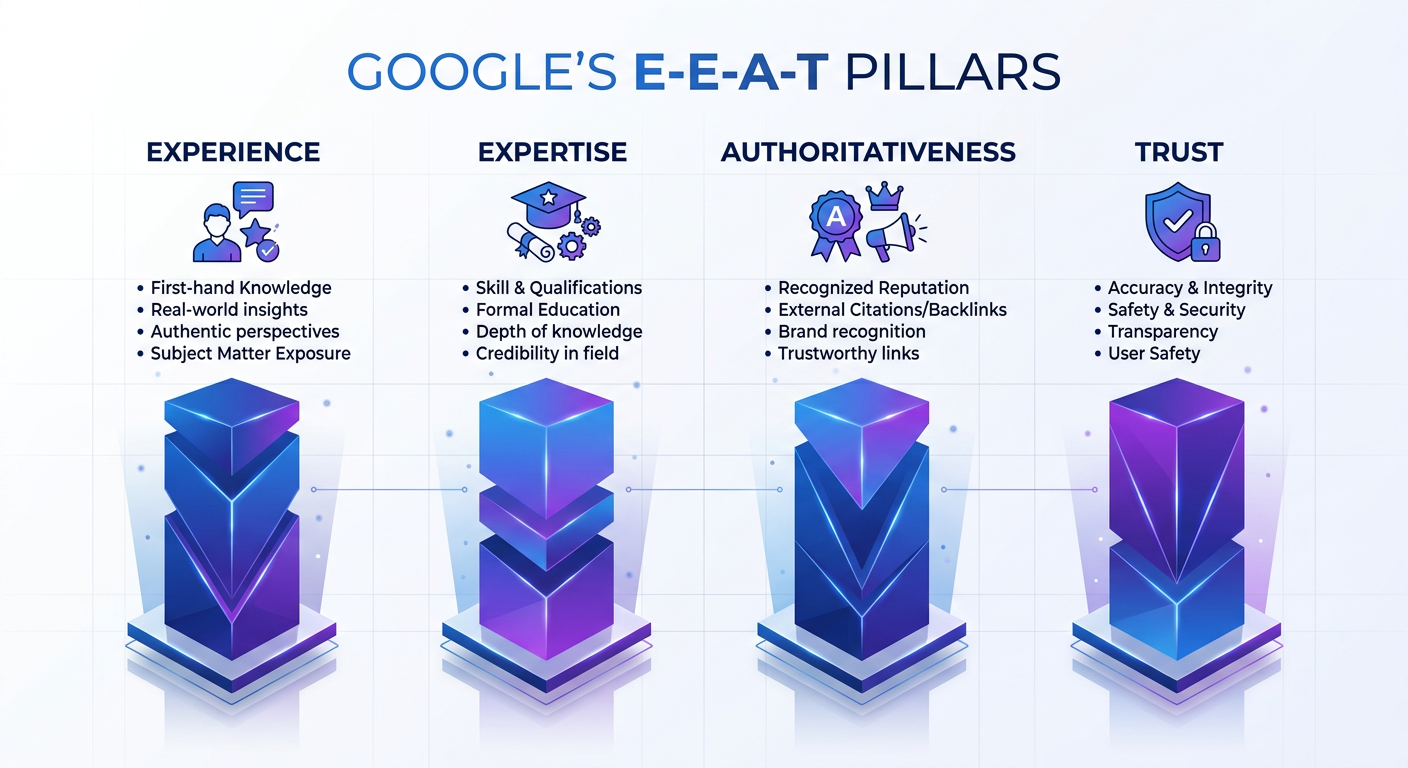
Google’s spam policies target content created “primarily for manipulating search rankings,” not content created by a specific tool. Their ranking systems reward content demonstrating E-E-A-T (Experience, Expertise, Authoritativeness, Trustworthiness) — and those signals are completely tool-agnostic. A well-researched AI article with original analysis, proper sourcing, and clear authorship can score higher on E-E-A-T than a hastily written human post.
The SpamBrain Factor
Google’s SpamBrain system — their AI-powered spam detection — has gotten dramatically better at identifying mass-produced, low-value content. But here’s the nuance most people miss: SpamBrain doesn’t have an “AI content detector” toggle. It evaluates quality patterns. Sites that published 500 thin AI articles overnight in 2024 got hammered. Sites that published 50 deeply researched AI articles over six months? Many of them saw traffic increases. The difference isn’t the tool — it’s the strategy.
What Actually Ranks in 2026: The Three Signals That Matter Most
Forget the theoretical debates. After analyzing what’s working right now in organic search, three ranking factors separate AI content that thrives from AI content that tanks.
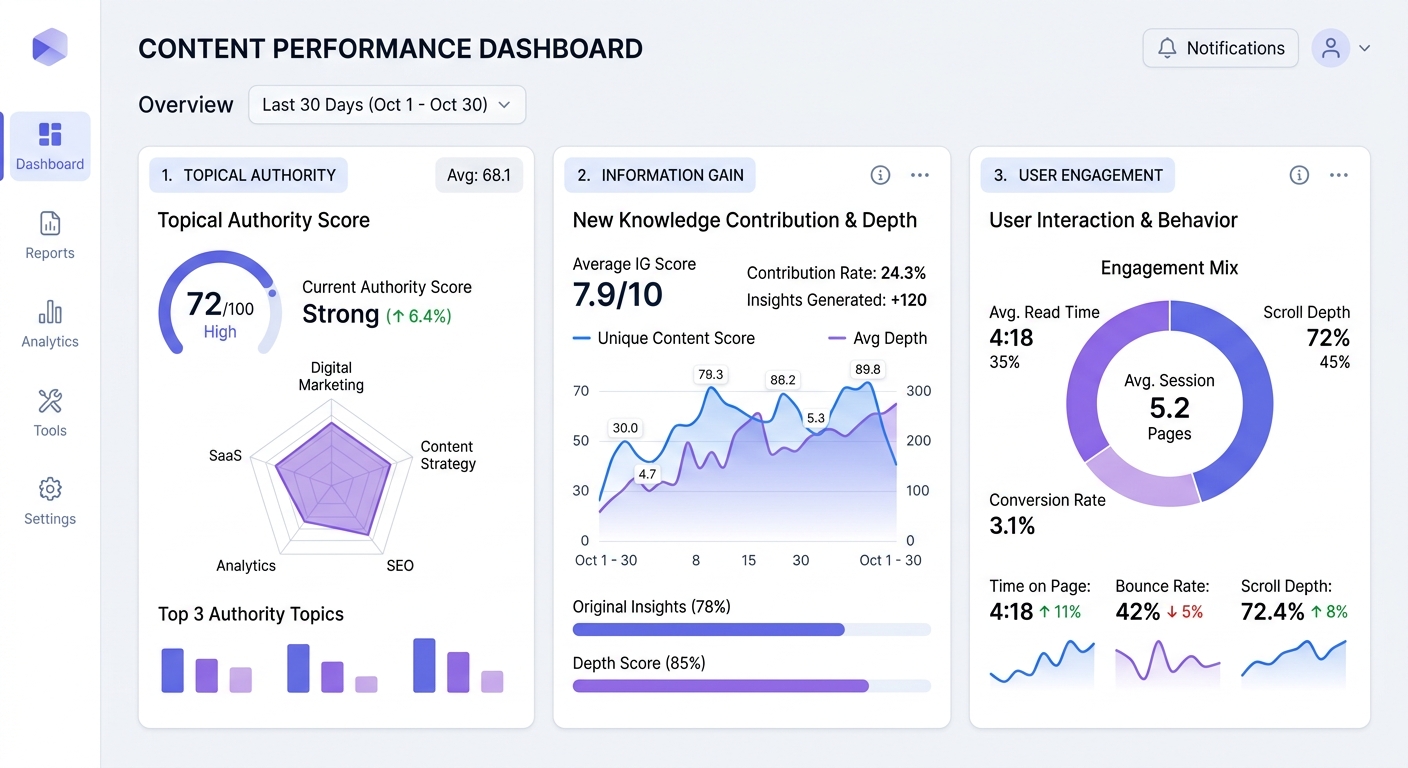
1. Topical Authority Over Individual Keywords
Google’s systems increasingly evaluate your site’s depth on a topic, not just whether one page targets one keyword. A single AI-generated article about “best project management tools” on a cooking blog will struggle. But 30 well-structured articles covering every angle of project management — comparisons, workflows, integrations, pricing guides — signals genuine authority. This is where AI shines: it can help you build comprehensive topical clusters faster than a human writer ever could.
2. Information Gain
Google’s information gain patent rewards content that adds something new to the conversation. If your AI article is just a rewritten version of the current top-10 results, it provides zero information gain. The AI content that ranks adds unique data, original frameworks, contrarian perspectives, or practical details competitors missed. The best AI workflows pull from multiple source types — not just the SERPs — to synthesize genuinely new insights.
3. User Engagement Metrics
Dwell time, pogo-sticking, scroll depth — Google uses interaction data as quality signals. AI content that’s generic gets skimmed and abandoned. AI content that’s specific, actionable, and well-structured keeps readers engaged. This isn’t about tricking algorithms; it’s about actually being useful.
The Real Risk: Not AI Itself, But How Most People Use It
Here’s where most publishers go wrong. They treat AI as a content vending machine: insert keyword, receive article, publish. That workflow produces exactly the kind of content Google’s systems are designed to suppress.
The most common failure modes we see:
- No gap analysis: Publishing AI content on topics you’ve already covered (or that nobody is searching for) wastes crawl budget and dilutes topical signals.
- Zero internal linking strategy: Orphaned AI articles don’t pass authority or help Google understand your site’s topical structure.
- Bulk publishing spikes: Going from 2 posts per month to 200 overnight is a pattern Google’s systems flag as manipulative, regardless of content quality.
- No human review layer: AI occasionally hallucinates facts, uses awkward phrasing, or misses nuance. A quick editorial pass catches these issues before they erode trust.
The risk isn’t that Google will detect your content is AI-generated and penalize you. The risk is that lazy AI workflows produce content that deserves to rank poorly — and it does.
How Smart Publishers Use AI Content to Win Organic Traffic
The publishers seeing 2x–5x organic traffic growth with AI aren’t doing anything magical. They’re following a disciplined process that most manual content teams can’t sustain at scale.
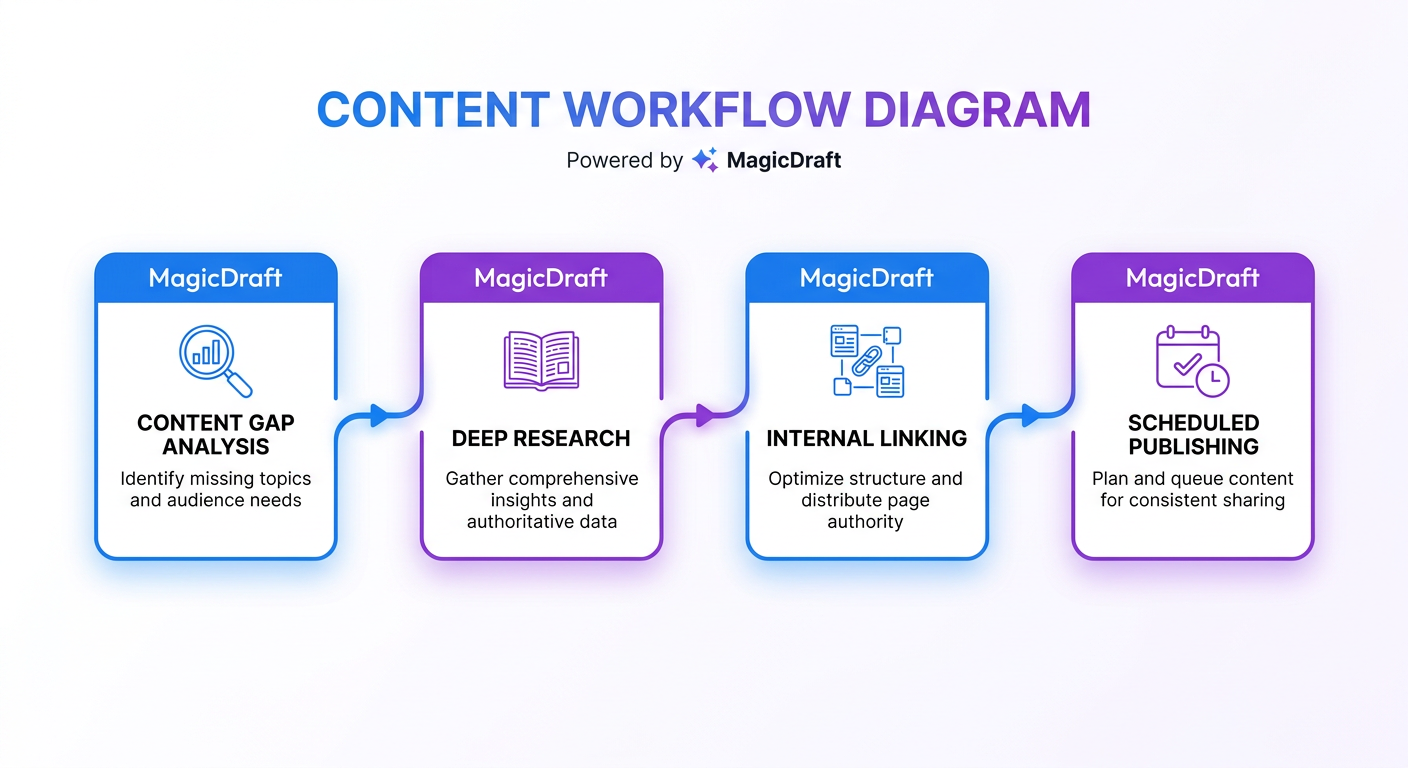
Step 1: Identify Genuine Content Gaps
Before writing a single word, they analyze their existing content to find topics their audience is searching for but their site doesn’t cover. This is the highest-leverage move in content strategy — and it’s exactly what MagicDraft’s content gap analysis automates. Instead of guessing what to write next, you’re filling proven demand.
Step 2: Produce Deeply Researched Articles
Each article pulls from multiple sources, includes specific data points, and covers subtopics competitors miss. This isn’t a 300-word summary — it’s a comprehensive resource that earns its ranking through genuine usefulness.
Step 3: Build Internal Link Architecture
Every new article gets woven into the existing content structure with contextual internal links. This distributes page authority, helps Google crawl your site efficiently, and keeps readers moving through your content. Automated internal linking — done well — is one of the most underrated SEO advantages of AI content tools.
Step 4: Publish Consistently, Not Explosively
A steady cadence of 3–8 articles per week looks natural and sustainable to search engines. It also gives you time to monitor performance and adjust your strategy based on what’s actually gaining traction.
Real-World Example: A Niche Site Owner’s 6-Month AI Content Experiment
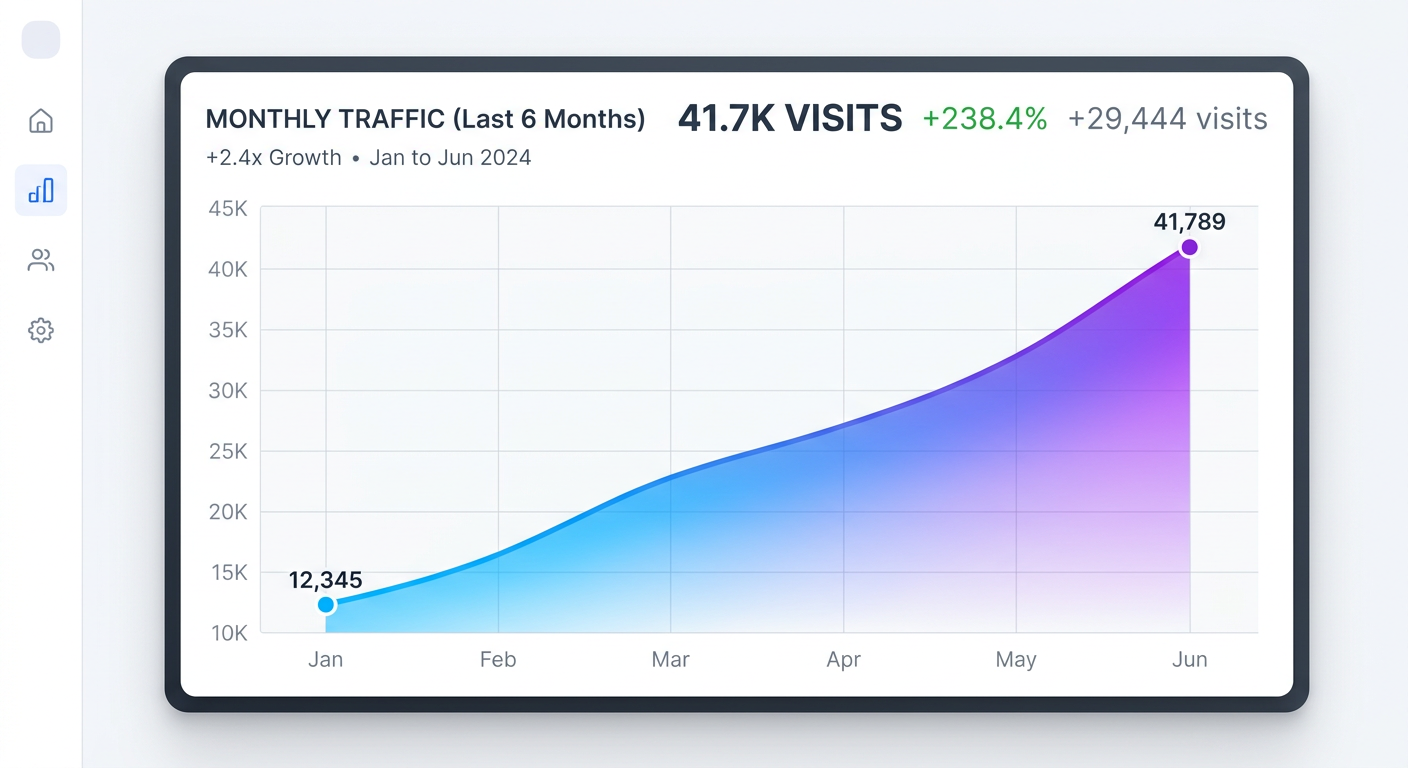
Consider a scenario we see frequently among WordPress site owners. A niche site in the personal finance space had 85 published articles and was getting roughly 12,000 organic visits per month. The owner was writing 2–3 posts monthly and had plateaued.
After running a content gap analysis, they discovered 140+ topics their competitors ranked for that they hadn’t touched — everything from specific tax scenarios to niche investment comparisons. Using an AI autopilot workflow, they published 6 deeply researched articles per week, each one targeting a verified gap and linked contextually to existing content.
The Results After Six Months
- Published articles: 85 → 240
- Organic monthly traffic: 12,000 → 41,000
- Indexed keywords (top 100): 2,100 → 7,800
- Average time on page: increased by 18% (because articles were more targeted to search intent)
- Google penalties: zero
The key insight? None of those 155 new articles were random. Every single one filled a documented gap. That’s the difference between AI content that works and AI content that gets ignored.
AI Content vs. Human Content: A False Dichotomy
The “AI vs. human” framing is the wrong way to think about this. The best content strategies in 2026 use both — and the line between them is blurring fast.
Think of it this way: most human-written blog content already uses AI tools. Writers use AI for research, outline generation, headline testing, grammar checking, and SEO optimization. At what point does “human content with AI assistance” become “AI content with human oversight”? The distinction is meaningless to Google and, frankly, to your readers.
What matters is the output: Is the article accurate? Does it answer the searcher’s question thoroughly? Does it provide something the other results don’t? Does it fit into a coherent content strategy?
A solo blogger using an AI autopilot tool to publish researched articles can now compete with a 10-person content team at a funded startup. That’s not cheating — that’s leverage. And Google has no interest in punishing efficiency.
The E-E-A-T Playbook for AI Content
If there’s one area where AI content needs extra attention, it’s E-E-A-T. Not because AI can’t demonstrate these qualities, but because most AI workflows skip the steps that signal them.
Experience
Google values first-hand experience. For YMYL (Your Money or Your Life) topics, this matters enormously. The fix: add editorial notes, personal observations, or real case data to AI drafts. Even a two-sentence anecdote from your actual experience transforms a generic article into one with genuine experiential depth.
Expertise
Cite specific sources. Reference data. Use precise terminology correctly. AI is actually quite good at this when given proper instructions — it can pull from authoritative sources and present technical information accurately. The key is verifying those citations in your review pass.
Authoritativeness
This is a site-level signal more than a page-level one. Building topical authority through comprehensive coverage — exactly what gap analysis enables — is the most effective way to establish authoritativeness. One hundred focused articles on a topic speak louder than a single “ultimate guide.”
Trustworthiness
Accurate information, transparent authorship, proper disclosures, and a secure site. None of these require human writing — they require editorial standards. Apply the same standards to AI content that you’d apply to freelancer content, and you’re covered.
What Google’s March 2025 and January 2026 Updates Tell Us
Google’s recent core updates have been remarkably consistent in their targeting. The March 2025 core update continued the pattern set by the 2024 helpful content updates: sites with thin, mass-produced content lost visibility, while sites with comprehensive, well-structured content gained.
The January 2026 update introduced refined signals around topical completeness — essentially measuring whether a site covers a topic thoroughly enough to be considered a genuine resource. Sites that had used AI to build deep topical clusters saw measurable ranking improvements. Sites that had used AI to spray hundreds of loosely related articles saw declines.
The Pattern Is Clear
Google isn’t getting better at detecting AI content. Google is getting better at detecting unhelpful content. The correlation between “AI-generated” and “penalized” exists only because so much AI content is produced carelessly. Produce it carefully, and you’re on the right side of every update.
For a breakdown of what features to look for in tools that help you stay on the right side, check out MagicDraft’s FAQ on how automated publishing works.
A Practical Checklist: Making AI Content That Google Rewards
Stop debating whether AI content is “okay” and start ensuring every AI article you publish passes this quality bar:
- Targets a verified content gap — not a random keyword you found in a spreadsheet
- Answers the search intent completely — if someone searches this query, would they need to click back and try another result?
- Includes specific details — numbers, examples, step-by-step instructions, named tools or methods
- Links contextually to related content — both internal links (building your site’s authority) and external citations (building trust)
- Has clear authorship — a real author bio, even if AI assisted the writing
- Reads naturally — no robotic phrasing, no keyword stuffing, no filler paragraphs that say nothing
- Gets a human review — even 10 minutes of editing catches hallucinations and awkward passages
- Publishes on a sustainable schedule — consistency beats volume every time
If every article on your site passes this checklist, Google doesn’t care whether you wrote it at 2 AM with a cup of coffee or whether an AI drafted it while you slept. The result is the same: a useful page that deserves to rank.
Stop Overthinking It — Start Publishing Strategically
The question isn’t whether AI content is good for SEO. The question is whether your AI content strategy is good for SEO. Google has made its position clear: quality content ranks, regardless of how it was produced. The publishers winning right now are the ones who stopped worrying about detection and started focusing on building genuine topical authority through consistent, well-researched, strategically linked content.
If you’re still manually brainstorming blog topics, writing every post from scratch, and hoping your publishing schedule doesn’t fall apart — you’re competing with one hand tied behind your back. Tools that automate gap analysis, deep research, internal linking, and scheduled publishing don’t just save time. They produce better strategic outcomes than most manual workflows.
Explore MagicDraft’s plans to see how AI-powered autopilot publishing can help you build the kind of content library that Google — and your audience — actually rewards.