To grow a new blog from zero to 10,000 monthly visitors in 2026, you need three things working together: a library of at least 80–120 well-targeted posts, a keyword strategy focused on low-competition long-tail queries, and a publishing cadence fast enough to build topical authority before competitors fill the gaps. Most bloggers stall at a few hundred visitors because they publish too slowly, target the wrong keywords, or run out of ideas after 20 posts. This guide walks you through the exact phases — from your first article to crossing the 10K threshold — with specific tactics, realistic timelines, and the automation shortcuts that make the math actually work.
Why Most Blogs Never Reach 10,000 Visitors
Here’s the uncomfortable truth: roughly 90% of blogs get fewer than 1,000 organic visitors per month, and most of them stay there permanently. The reason isn’t bad writing. It’s bad math.
Getting to 10,000 monthly visitors from organic search means you need enough indexed pages ranking for enough queries to collectively pull in that traffic. If an average blog post brings in 80–150 visitors per month (a realistic range for long-tail content), you need somewhere between 70 and 125 posts performing at that level. Most solo bloggers publish 2–4 posts per month. At that pace, it takes 2–3 years just to build the library — and by then, half those early posts are outdated.
The Three Killers of Blog Growth
- Publishing too slowly: Google rewards topical depth. Four posts a month in a competitive niche won’t establish authority fast enough.
- Targeting the wrong keywords: Going after head terms with 10,000+ monthly search volume when your domain authority is 5 is a guaranteed way to rank on page 7.
- Running out of ideas: Most bloggers exhaust their obvious topic list within 30 posts and start guessing, leading to duplicate content, cannibalization, or irrelevant tangents.
The bloggers who actually hit 10K share a common trait: they treat content production as a system, not a creative hobby. They plan in bulk, publish consistently, and use tools to find the gaps their competitors missed.
Phase 1: Foundation (Months 1–2) — Keyword Research and Site Architecture
Before you write a single word, you need a keyword map with at least 100 target topics. Not 20. Not 50. A hundred. This isn’t busywork — it’s the difference between a blog that plateaus at 500 visitors and one that compounds to 10K.
How to Build a 100-Topic Keyword Map
Start with 5–8 seed keywords that describe your niche. Plug them into a keyword tool (Ahrefs, SEMrush, or even Google’s free Keyword Planner) and filter for queries with 100–1,000 monthly search volume and a keyword difficulty under 30. These are your bread-and-butter targets — queries where a new site can realistically rank in the top 10 within 3–6 months.
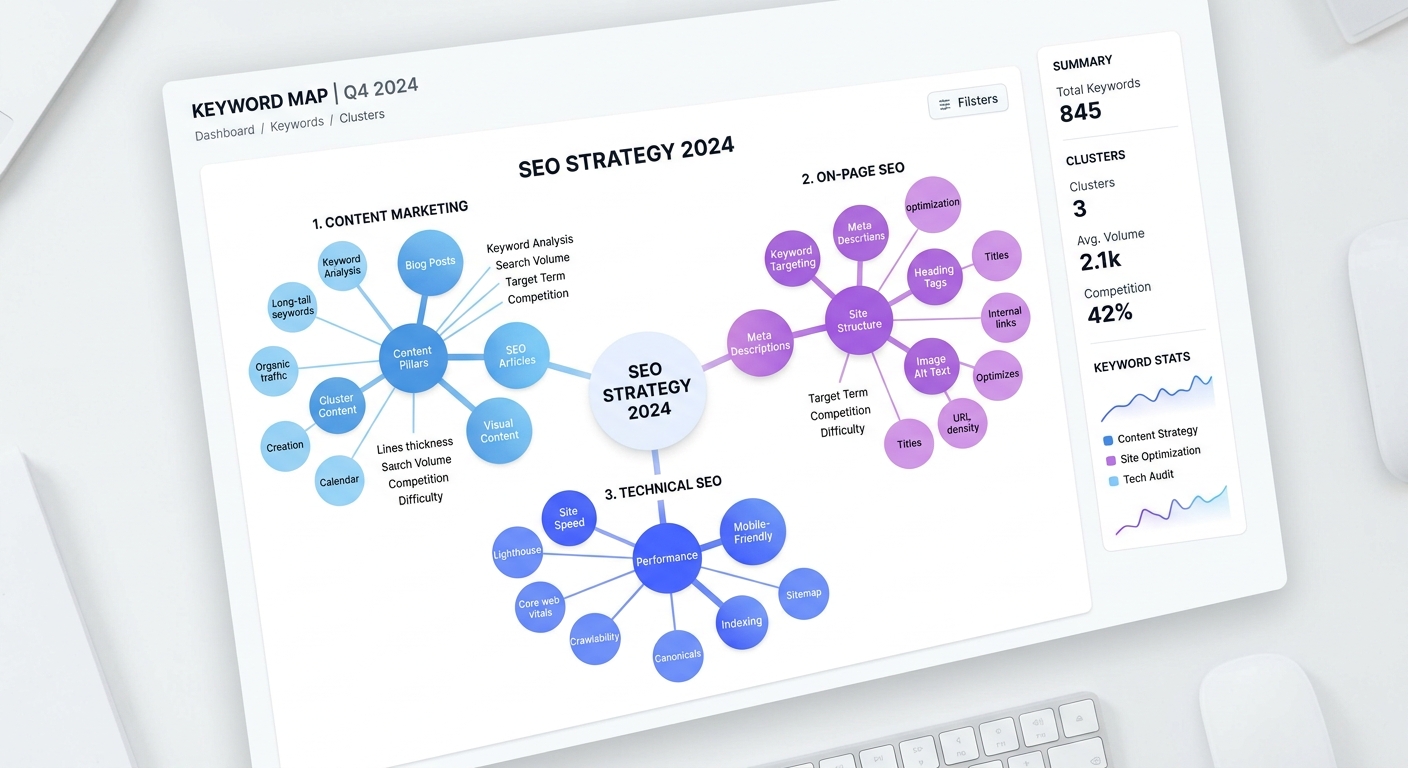
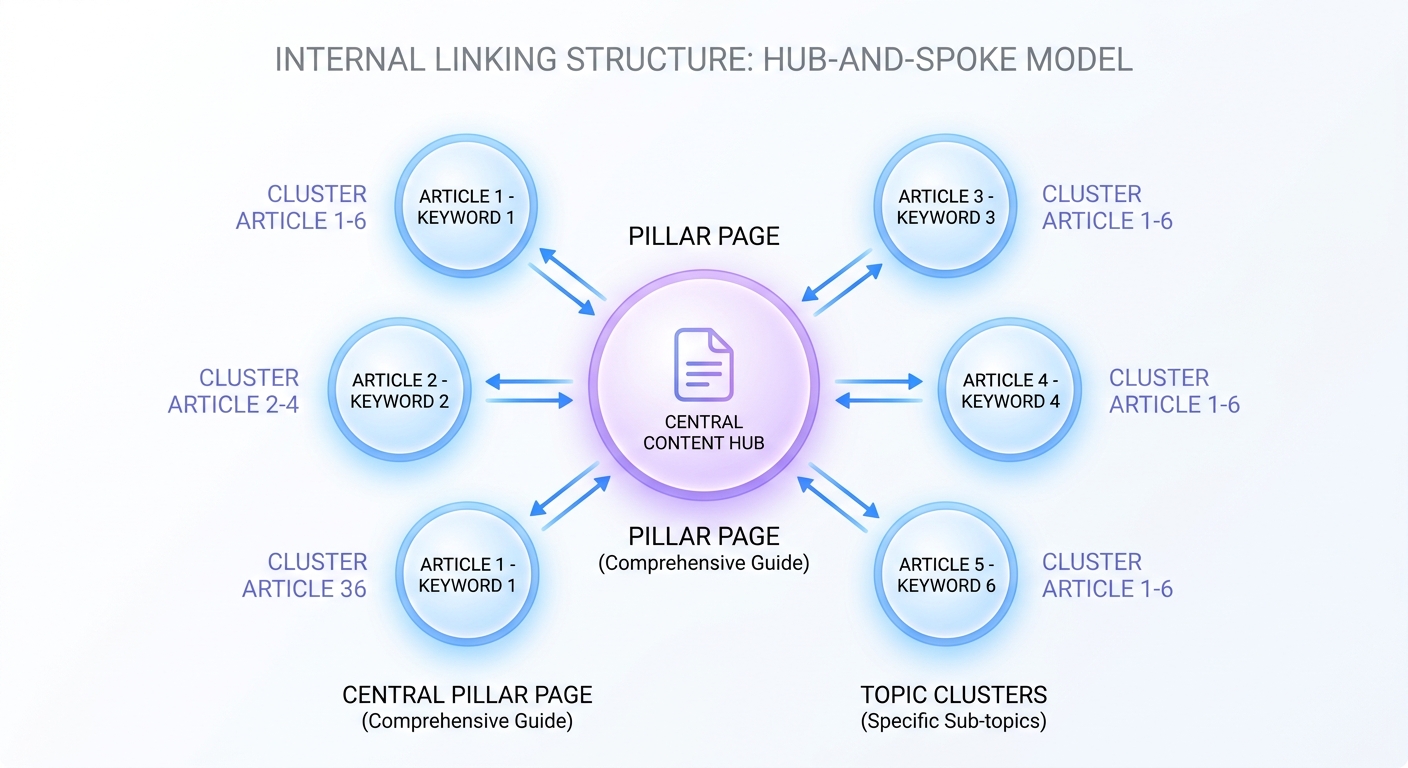
Group these keywords into topical clusters. Each cluster should have one pillar topic (broader, higher volume) supported by 5–10 cluster articles (narrower, lower competition). For example, if you run a personal finance blog, a pillar might be “how to budget on a low income” with clusters like “50/30/20 budget rule for minimum wage,” “free budgeting apps that actually work,” and “how to save money on groceries under $200/month.”
Site Architecture That Signals Authority
Create category pages that mirror your topical clusters. Each category becomes a hub that links to its cluster articles. This isn’t just organizational — it tells Google your site has depth on that topic. A flat blog with 100 uncategorized posts looks like a junk drawer. A structured blog with 8 categories, each containing 12–15 interlinked posts, looks like an authority resource.
If you’re on WordPress, this is where a tool that identifies content gaps and publishes researched articles automatically pays for itself immediately. Instead of spending 15 hours manually mapping competitor content, automated gap analysis shows you exactly which subtopics your site is missing.
Phase 2: Rapid Publishing (Months 2–5) — Building Your Content Library
This is where most bloggers fail. The math is simple but brutal: you need to publish 15–25 articles per month for 3–4 months to build a library large enough to generate compounding traffic. At 4 posts a month, you’re looking at 18+ months just to reach critical mass. At 20 posts a month, you can get there in under 5 months.
Quality vs. Quantity Is a False Dichotomy
The old advice of “publish one amazing post per week” made sense in 2018 when there were fewer blogs competing for the same queries. In 2026, the sites winning in search are the ones that publish high-quality content at scale. That means 1,500–2,500 word articles that are well-researched, properly structured with H2s and H3s, and answer the searcher’s question better than what’s currently ranking.
You don’t have to choose between good and fast. You have to choose between doing it yourself (slow) and building a system that handles the heavy lifting (fast).
What a Realistic Publishing Sprint Looks Like
For instance, a niche site owner in the outdoor gear space used an AI autopilot workflow to publish 22 articles per week for six weeks — targeting long-tail queries like “best ultralight backpacking tent under 2 lbs” and “how to waterproof hiking boots at home.” Each article was auto-researched against top-ranking competitors, included internal links to related cluster posts, and was published directly to WordPress without manual intervention. By month four, the site had 130+ indexed pages and was pulling 3,200 organic visitors per month — up from zero.
The key insight: Google doesn’t penalize volume. It penalizes thin, duplicative, or unhelpful content. If each article targets a unique query and genuinely answers it, more is better.
Targeting the Right Keywords at Each Stage
Your keyword strategy should evolve as your domain authority grows. Trying to rank for “best CRM software” when your site is two months old is like entering a marathon with no training. You’ll burn energy and finish nowhere.
Months 1–3: Pure Long-Tail (KD 0–15)
Target queries with keyword difficulty scores under 15 and search volumes between 50–500. These are hyper-specific questions that bigger sites ignore. Examples: “can you use Notion as a CRM for freelancers” or “how to add alt text to images in WordPress Gutenberg.” You won’t get massive traffic from any single post, but 50 posts each bringing 50–100 visitors adds up to 2,500–5,000 monthly visitors.
Months 3–6: Medium-Tail (KD 15–30)
Once you have 60+ indexed pages and some backlinks, you can start targeting queries in the 500–2,000 search volume range with moderate competition. Your topical authority from the long-tail phase gives you a ranking advantage here — Google already sees your site as relevant for the broader topic.
Months 6+: Pillar Content (KD 25–40)
Now you can go after the pillar topics — comprehensive guides, comparison posts, and “best of” roundups. These pages should link to 10–15 of your existing cluster articles, creating a web of internal relevance that boosts the entire cluster.
This staged approach is exactly why automated content gap analysis matters. It continuously identifies which low-competition queries you haven’t covered yet, so you never waste time targeting something too competitive or something you’ve already addressed.
Internal Linking: The Most Underrated Traffic Lever
If your blog has 80 posts and they’re not linking to each other, you’re leaving rankings on the table. Internal linking is the single most impactful on-page SEO tactic that bloggers consistently neglect — probably because it’s tedious to do manually.
Why Internal Links Matter More Than You Think
Internal links do three things: they help Google discover and crawl new pages faster, they distribute page authority (link equity) across your site, and they keep readers on your site longer (reducing bounce rate, increasing pages per session). A blog post with 5–8 relevant internal links consistently outranks an identical post with zero internal links.
The Practical Problem
When you have 20 posts, internal linking is manageable. When you have 100+, it becomes a nightmare. You forget which posts exist, you miss obvious connections, and older posts never get updated with links to newer content. This is one of the biggest pain points we hear from bloggers scaling their content — they know internal linking matters, but they simply can’t keep up.
The fix is automation. Tools that analyze your entire content library and suggest (or automatically insert) contextual internal links save hours per week and ensure no post is an orphan page. Every new article should link to 3–5 existing posts, and every existing post that’s topically related should get a link back to the new one.
A Simple Internal Linking Framework
- Every cluster article links to its pillar page and 2–3 sibling cluster articles.
- Every pillar page links to all its cluster articles.
- Every new post triggers a review of 5–10 existing posts for outbound link opportunities.
- Anchor text should be descriptive and varied — never the same phrase repeated across 20 links.
Content Gaps: Finding What Your Competitors Missed
Most bloggers create content based on what they think their audience wants. The bloggers who hit 10K visitors create content based on what their audience is actually searching for — and what competing sites haven’t adequately covered.
What Is a Content Gap?
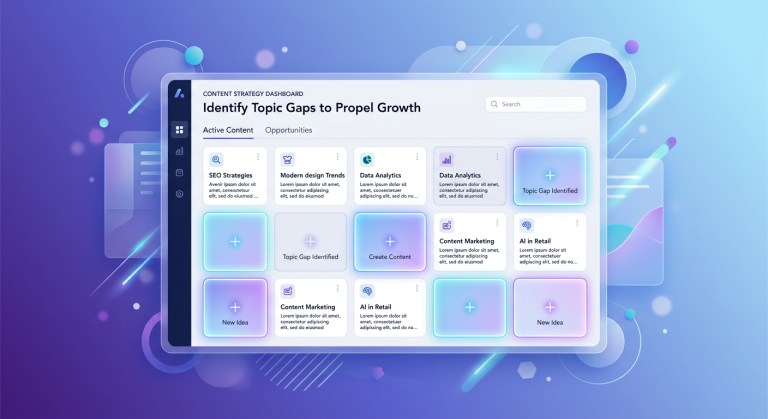
A content gap is a topic or query that your competitors rank for but you don’t, or a topic that has search demand but no one has covered well. These are free opportunities. Someone is already searching for the answer — you just need to provide it.
How to Find Content Gaps Systematically
The manual approach: take your top 5 competitors, export their ranking keywords, compare them to yours, and filter for queries where they rank and you don’t. This works, but it takes 3–5 hours per competitor and needs to be repeated monthly as the landscape shifts.
The automated approach: connect your WordPress site to a tool that continuously crawls your content and your competitors’, identifies missing topics, and queues them for publishing. For example, a SaaS marketing manager running a B2B blog connected their site to an AI-powered content gap and autopilot tool and discovered 47 long-tail topics their three main competitors ranked for that they hadn’t touched. Within 8 weeks of publishing those gap articles, organic traffic increased by 34%.
Content gaps aren’t a one-time exercise. New queries emerge constantly, competitors publish new content, and search intent shifts. The blogs that grow fastest treat gap analysis as an ongoing process, not a quarterly project.
On-Page SEO That Actually Moves the Needle
You can publish 200 articles, but if they’re not optimized for search, you’re building on sand. The good news: on-page SEO in 2026 isn’t about keyword stuffing or exact-match title tags. It’s about structure, intent matching, and user experience.
The Non-Negotiable On-Page Checklist
- Title tag: Include the primary keyword naturally. Keep it under 60 characters. Make it compelling enough to earn the click over the other 9 results.
- Meta description: 150 characters, includes the keyword, and gives a specific reason to click — not a vague summary.
- H2/H3 structure: Every post should have 4–8 H2 sections with H3 subsections where needed. This helps Google understand the content hierarchy and improves featured snippet eligibility.
- First 100 words: Answer the searcher’s question immediately. Google’s helpful content system rewards pages that deliver value fast.
- Image alt text: Descriptive, keyword-relevant, and specific. “Blog traffic growth chart showing monthly visitors over 6 months” beats “chart.png.”
- Internal links: 3–8 per post, with descriptive anchor text pointing to topically related content.
Intent Matching Is Everything
Before writing any post, search the target keyword and study the top 5 results. Are they how-to guides? Listicles? Product comparisons? Match the format. If Google is ranking 2,000-word tutorials for your keyword, don’t publish a 500-word opinion piece and expect to compete.
The Publishing Cadence That Compounds Traffic
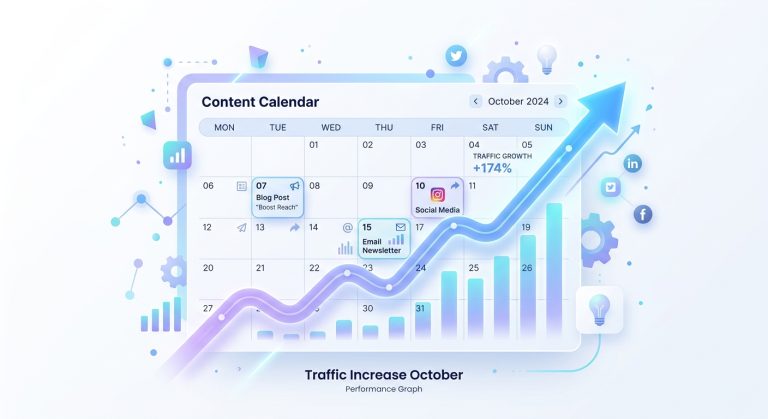
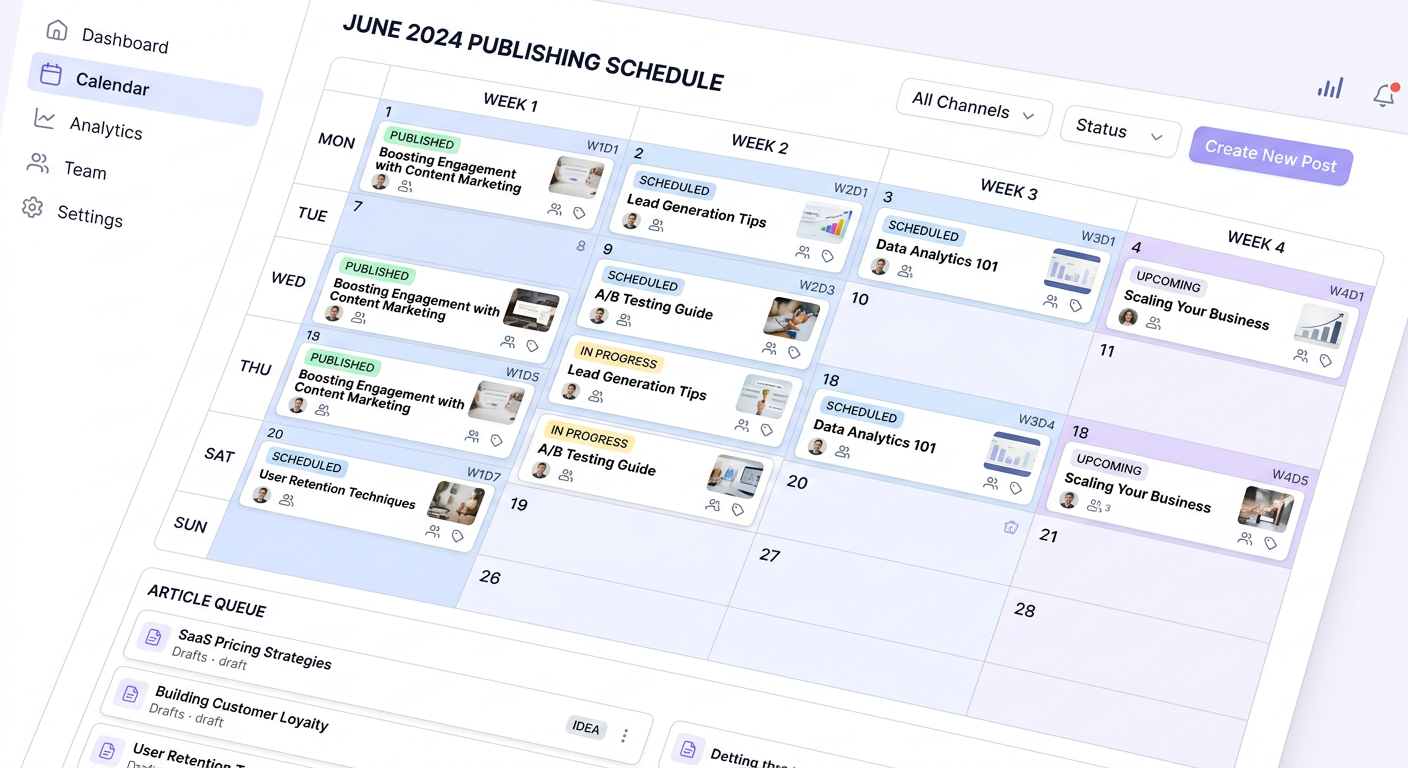
Consistency beats intensity. Publishing 30 articles in one week and then nothing for two months confuses Google’s crawl scheduler and sends mixed signals about your site’s freshness. A steady cadence of 4–5 posts per week, maintained over months, is the pattern that compounds.
Why Consistency Matters for Crawl Budget
Google allocates a crawl budget to every site — essentially, how often Googlebot visits to discover new content. Sites that publish regularly get crawled more frequently, which means new posts get indexed faster. A blog that publishes daily will typically see new posts indexed within 24–48 hours. A blog that publishes sporadically might wait 1–2 weeks.
Automating the Cadence
The biggest challenge isn’t knowing you should publish consistently — it’s actually doing it. Life gets in the way. Client work piles up. You lose motivation after post #35. This is where an autopilot publishing system earns its keep. Set a target cadence (say, 5 posts per week), queue your topics from the gap analysis, and let the system research, write, optimize, and publish on schedule.
One agency owner managing 8 client blogs told us they went from spending 60+ hours per week on content production to under 10 hours — mostly spent reviewing and approving auto-generated drafts. Their clients’ combined organic traffic grew 4x in seven months. The secret wasn’t better writing. It was more consistent writing.
Curious what a system like this costs? Check the MagicDraft plans and pricing to see how it scales for solo bloggers versus agencies.
Tracking Progress: The Metrics That Actually Matter
Checking your traffic daily is a recipe for anxiety, not insight. Here are the metrics to track weekly and monthly, and what they actually tell you about your trajectory toward 10K visitors.
Weekly Metrics
- Indexed pages in Google Search Console: Are your new posts getting indexed? If not, you have a crawlability or quality issue.
- Impressions (Search Console): Impressions grow before clicks. If impressions are rising week over week, clicks will follow within 2–4 weeks.
- Average position for target keywords: You want to see gradual movement from positions 30–50 into the top 20, then top 10. This takes 6–12 weeks per post.
Monthly Metrics
- Organic sessions (Google Analytics): Your north star. Track month-over-month growth percentage, not absolute numbers. A 20–30% monthly growth rate is on track for hitting 10K within 8–10 months.
- Pages per session: If this is above 1.5, your internal linking is working. Below 1.2 means readers are bouncing without exploring.
- Top-performing posts: Identify your top 10 traffic drivers each month. Can you write more content in those clusters? Can you update those posts with fresher data or deeper sections?
The Growth Curve Is Not Linear
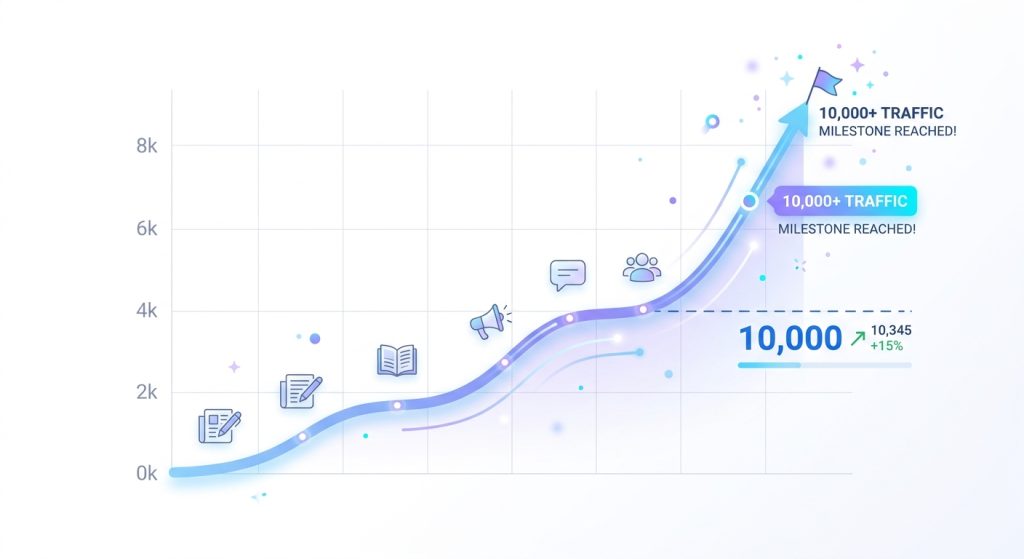
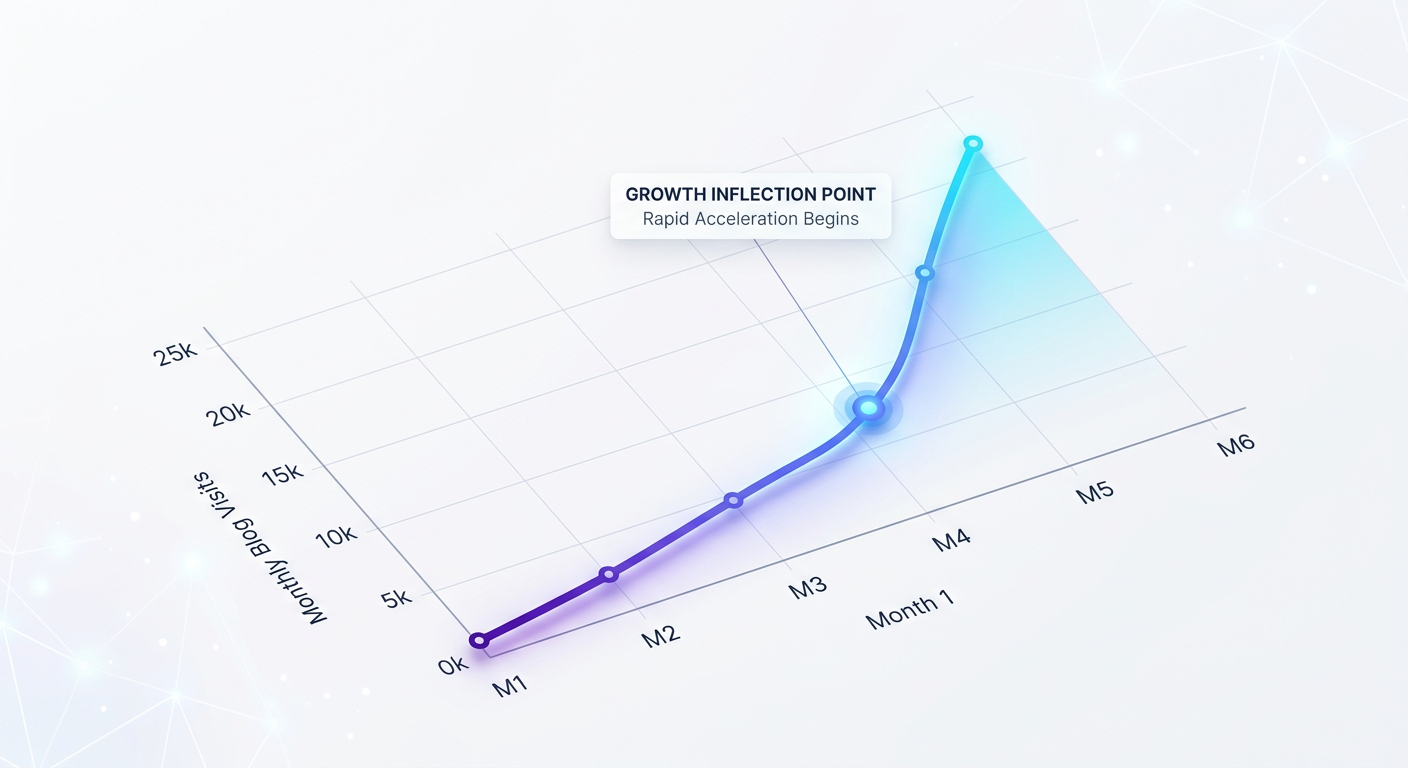
Expect almost nothing for the first 2–3 months. This is the “Google sandbox” period where your content is indexed but barely ranking. Months 3–5 bring a slow trickle — maybe 500–1,500 visitors. Months 5–8 is where compounding kicks in: older posts climb in rankings, new posts get indexed faster, and topical authority snowballs. The jump from 3,000 to 10,000 often happens faster than the jump from 0 to 3,000.
Your Roadmap to 10K: Putting It All Together
Let’s distill everything into an actionable timeline you can start executing today.
Month 1
- Build a keyword map with 100+ low-competition topics grouped into 6–10 topical clusters.
- Set up your WordPress site with proper category structure mirroring your clusters.
- Publish your first 10–15 articles targeting KD < 15 queries.
Months 2–4
- Ramp to 15–25 articles per week. Use AI autopilot tools to maintain quality at this pace.
- Run content gap analysis monthly to refresh your topic queue.
- Implement internal linking across every new and existing post.
Months 5–7
- Start targeting medium-competition keywords (KD 15–30).
- Publish pillar content that links to your existing cluster articles.
- Update your top 20 performing posts with fresh data, new sections, and additional internal links.
Months 7–10
- Monitor compounding traffic. You should be seeing 5,000–8,000 monthly visitors by now.
- Double down on clusters that are performing — publish more content in those topics.
- Prune or consolidate underperforming posts that aren’t ranking after 6 months.
The difference between bloggers who hit 10K and those who stall at 500 isn’t talent or budget — it’s systems. A structured keyword strategy, consistent publishing cadence, automated gap analysis, and disciplined internal linking will get you there. If you want to skip the manual grind and let an AI handle the research, writing, and publishing while you focus on strategy, MagicDraft was built exactly for this workflow. Connect your WordPress site, let it find the gaps, and watch the library — and the traffic — compound.
Have questions about how autopilot publishing works or what plan fits your blog? The MagicDraft FAQ page covers the most common questions about setup, content quality, and scaling.